
Research
We are interested in conformational control: creating structures that fold or arrange themselves into persistent structures in solution. We make aromatic-rich ligands that can then be combined with metal ions to self-assemble into sequences that possess the information to adopt these conformations. These include cages, foldamers and interlocked architectures. We use strategies to control the way ligands come together at metal ions and maintain fidelity of connectivity.
We hope to develop synthetic systems with the defined spatial positioning of components and switchability that allows biological molecules like proteins to carry out regulated tasks.
An example of this structural control can be seen below in our 2021 paper, where complementary ligand pairings control connectivity, and conformation in the generated sequences was driven through π-π interactions.

We have similarly used this approach to generate structural complexity in coordination cages, again exploiting ligand pairings with complementarity driven through denticity or hydrogen-bonding capability. This allowed us to synthesise the first example of a lantern-shaped cage that was comprised of four different low-symmetry ligands, with positional and orientational control.

Lately, our interest in lantern-shaped cages has led to work exploring how to synthesise them efficiently using Pt(II), which has traditionally been problematic due to the inert nature of this metal ion interfering with self-assembly. We have a new methodology and starting material which allows us to synthesise these cages in as little as 1.5 hours, and we report the first Pt(II) examples of low-symmetry homolepic, heteroleptic and multicavity cages in this class.

The ability of defined conformations to be altered in response to stimuli is a key facet in the progression to functional molecules with on-off functionality. In the example shown here, we use junctions to form a trefoil entangled tetrahedron. This can be reversibly switched through heating to convert into a non-interlocked dual metallocycle. Importantly, the use of junctions means that we were able to circumvent dilution effects, which typically skew equilibrium position in self-assembled metallo-systems.
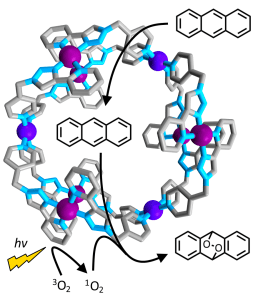
One of the end goals is the development of the capacity for these systems to interact with guests or substrates. We have previously shown that assemblies built from these types of components can interact with guests and carry out photocatalytic transformations on them.
 Preston Group Metallosupramolecular Chemistry